
Plum lekvar takes about nine hours, and eight of them are scraping.
This is how a batch of thick plum lekvar gets made in our Austin kitchen: prune plums halved by hand with the skins on, wide shallow pans over low heat, two tests that decide whether it is finished, then jars filled hot and labelled with the fruit and the date.

From crate to labelled jar
-
01
Sorting and pitting, skins on
60 to 75 minutes for 40 lbPrune plums arrive in crates and get tipped onto the steel table. Soft ones go in the pan, split and weeping ones go in the compost bucket, and anything with mold goes straight out. Then they are halved with a paring knife and the pit flicked out with a thumb. No machine. A pitting machine tears the skin and we want the skin.
The skin is where the color and most of the natural pectin sit. Peel a prune plum and you get a dull brown butter that needs help to set. Leave the skin on and the finished lekvar is nearly black with a purple edge where the light hits it. By the end of an hour of pitting, your fingers are stained to the knuckle.
-
02
The first hour, when it is still fruit
45 to 60 minutesHalves go into wide shallow pans with sugar weighed at roughly one part to four parts fruit. No water. The plums give up plenty on their own within ten minutes and the pan goes from dry heap to purple slurry. This is the only part of the day that looks like cooking in a hurry.
Once everything has collapsed we break it down with a potato masher, not a blender. A blender whips air in and the finished lekvar comes out pale and foamy. Mashed by hand, it stays dense.
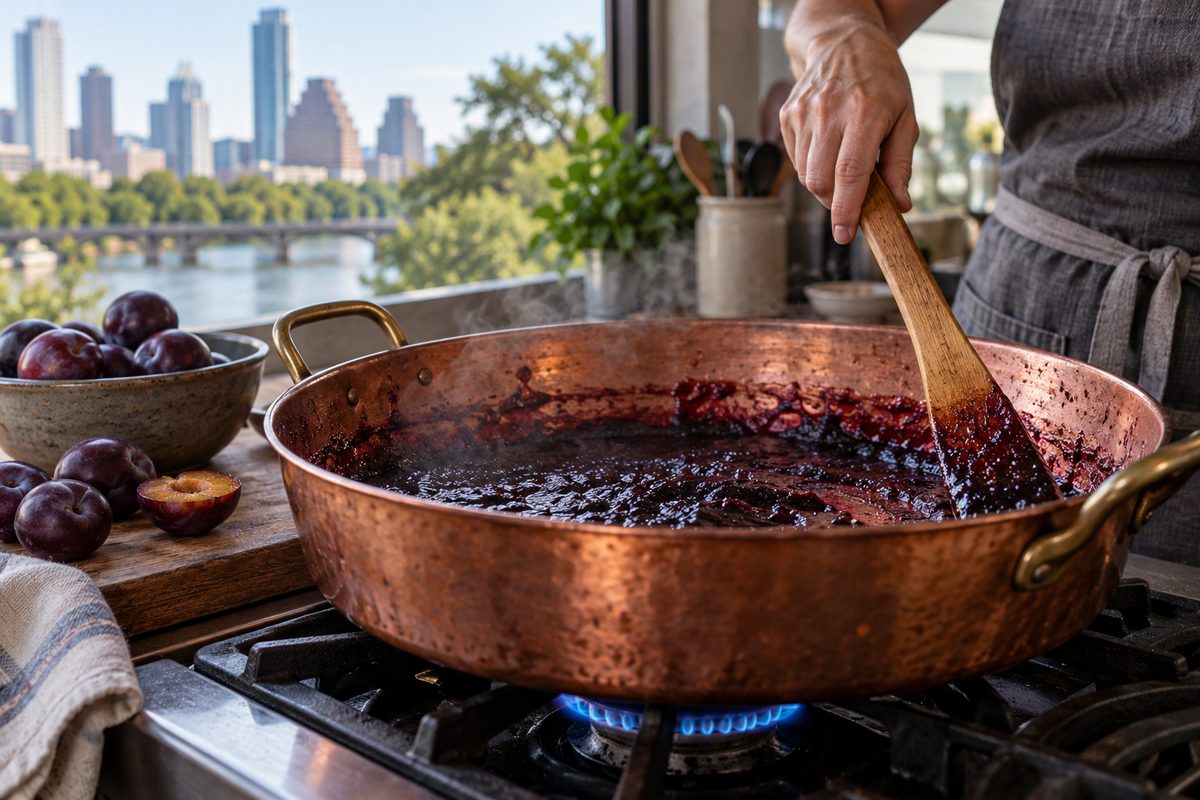
Hour six. The spatula leaves a track that closes slowly. -
03
The long reduction
Seven to eight hoursHeat down low and the pans stay there. Every ten or fifteen minutes someone walks past with a long wooden spatula and scrapes the bottom corner to corner. Miss two rounds in the last hours and you get a scorched layer that taints the whole pan. There is no rescuing it. That batch becomes a story instead of a product.
Wide pans do the work. Reduction happens at the surface, so a shallow pan with a lot of open area drives the water off in a fraction of the time a stockpot would take. Three pounds of fruit come out as roughly one pound of lekvar. The color walks from bright purple through brick to near black, and the smell changes from fresh plum to something closer to prune and caramel around hour six.
Apricot runs shorter, about five hours, and needs watching harder because the sugars catch faster. Quince takes about five hours to turn from pale to deep amber. Blackberry and cherry jams are off the stove inside an hour, because there the point is to keep the fruit bright rather than drive it dark.
-
04
Two tests, no thermometer
Both, every batchA plate lives in the freezer all day. A teaspoon of lekvar goes onto the cold plate, back in the freezer for one minute, then a finger pushed through the middle. If the two edges stay put and the surface wrinkles, it is set. If the gap fills back in, the pan goes on for another half hour.
The second test is cruder and tells us more. Lift a spoonful and hold the spoon sideways. If it runs off a spoon held sideways, it is not finished. For the tub and pail batches going to bakeries there is a third check: a round of kolache dough gets filled and baked at 375°F, and we look at whether the well stays full.
-
05
Jarring, sealing and labelling
An hour, then overnight to coolJars go through the dishwasher on the hot cycle and come out to the bench still warm, because cold glass and hot lekvar is how you crack a jar. Filling is done with a ladle and a wide funnel, a quarter inch of headspace, rim wiped, lid on finger tight. Tubs and pails are filled the same way and get their lids pressed down by hand.
They cool upside down overnight, then every lid gets a thumb press. No flex, it stays. A click, it goes back. The label carries the fruit, the net weight and the batch date, and the same line goes on the side of every tub so a baker can tell two deliveries apart on a shelf.
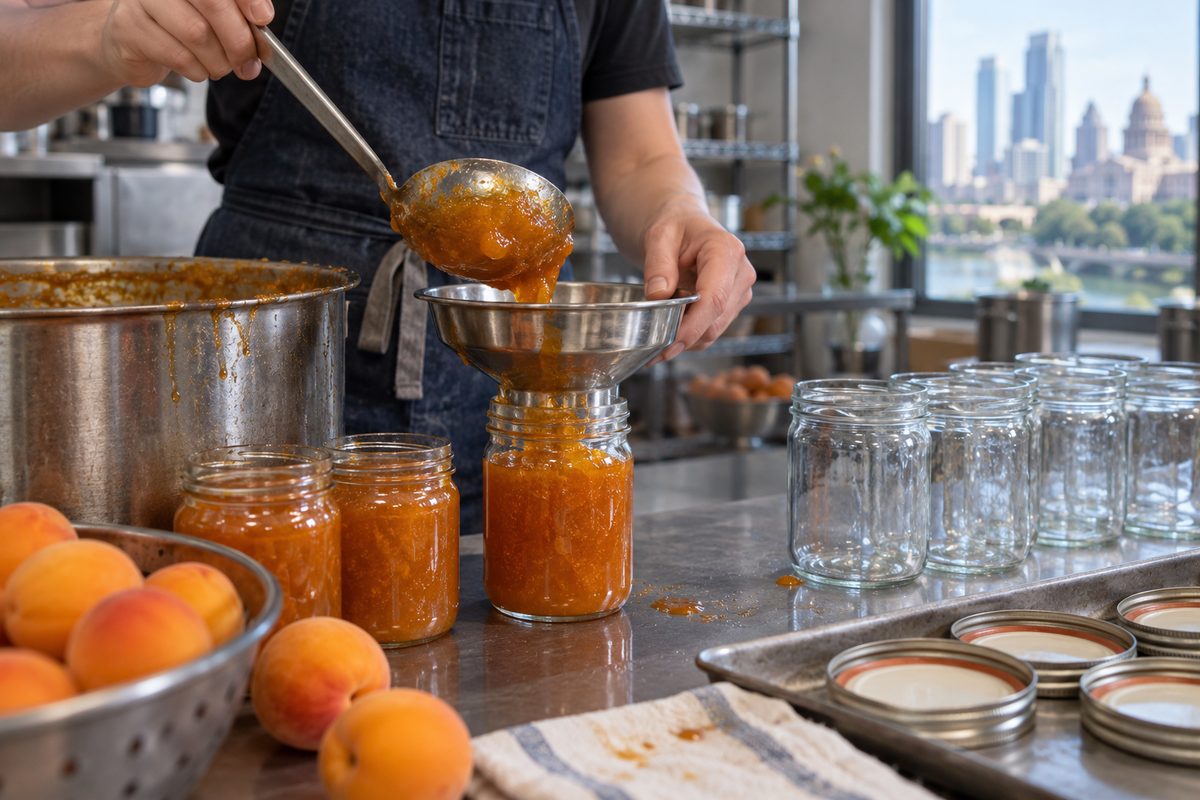
Apricot going in hot. Quarter inch of headspace, a few honest drips.


If it runs off a spoon held sideways, it is not finished.
That is the whole standard, and it is the reason a jar costs what it costs. Nine hours of gas and someone in the kitchen scraping a pan is more expensive than a thickener and a boil. One part sugar to four parts fruit. You will taste the plum first.
Low heat, wide pans, scraped every ten to fifteen minutes from the first hour to the last.
One part sugar to four parts fruit by weight in the lekvars. A reduced 1:6 batch cooks longer and costs $1 more per 8 oz equivalent.
Roughly three pounds of pitted plums for one pound of finished lekvar. The rest leaves as steam.
A 2 lb tub fills roughly 60 kolaches. We have counted.
How long each one sits on the stove
| Product | Active cook | Sugar | Set comes from |
|---|---|---|---|
| Plum lekvar | ~9 h | 1:4 | Skins and reduction |
| Apricot lekvar | ~5 h | 1:4 | Natural pectin in the fruit |
| Damson plum butter | ~6 h | 1:4 | Reduction, then sieved |
| Quince paste | ~5 h | 1:3 | Quince pectin, then set in a tray |
| Cider apple butter | ~4 h | 1:5 | Cider reduced first, then the fruit |
| Pear cardamom butter | ~4 h | 1:5 | Reduction |
| Sour cherry jam | ~1 h | 1:4 | Grated apple and lemon |
| Blackberry jam | ~1 h | 1:4 | Seeds, grated apple and lemon |
| Fig and orange jam | ~2 h | 1:4 | Figs and orange peel |
| Hill Country peach preserves | ~1.5 h | 1:4 | Chunks held in a light syrup |
What never goes in the pan
-
Boxed pectin
No pectin from a box. Apricots and quince bring their own. Added pectin sets a jam before the fruit has concentrated, which is how you get a firm, sweet, flavorless spread.
-
Modified starch
Starch is what makes supermarket plum filling slide out of a kolache in the oven. It thickens cold and lets go hot. We thicken by taking water out instead.
-
A blender
It beats air into the fruit. The butter looks lighter in the pan and then separates in the jar. A masher and a sieve do the same job without the foam.
-
A scorched batch sold anyway
If someone misses the scrape and the bottom catches, the pan is lost. It tastes of burnt sugar through the whole batch and no amount of stirring hides it. We have thrown out a full pan twice.
Questions about the method
Why wide pans instead of a stockpot?
Reduction happens at the surface. A wide shallow pan gives several times the open area of a tall pot, so the water leaves faster and the fruit spends less time cooking. A stockpot of plum would take all day and taste of scorch.
Do you use pectin?
No pectin from a box. Apricots and quince bring their own. In the jams we lean on a grated green apple and lemon juice instead.
Why is there no cinnamon in most of the range?
Nine hours of reduction concentrates the fruit. Spice on top of that covers what we spent the day building. Only the pear butter carries a spice, green cardamom, and it is measured in grams.
Can I watch a batch being cooked?
The kitchen is small and three of us are working in it, so no tours. If you are picking up an order and a pan is going, you will see it from the door, and someone will answer whatever you want to ask.